Exodus 3:8—4:5
Ministries > Thru the Bible with Dr. J. Vernon McGee
https://www.oneplace.com/ministries/thru-the-bible-with-j-vernon-mcgee/
Facebook Twitter Instagram YouTubeAre you willing to be weak? Dr. McGee says, “God has chosen the weak things of the world to confound the mighty.” When God redeems us from weakness, He always redeems us to His strength. In Exodus 3, discover how our Creator—the almighty I AM—saves Moses and the people of Israel from themselves and uses their weakness to show His never-failing strength.
References
Steve Schwetz: What kind of person does God use to accomplish his will in each generation? Can he really use everyday people like you and me? Well, welcome to Thru the Bible with Dr. J. Vernon McGee. I'm Steve Schwetz, and as we turn to Exodus chapter 3, we're going to discover why God chooses certain men and women to fulfill his purposes, and the answer may surprise you. So as you hop aboard the Bible bus, let's make room for our friend and Thru the Bible's president Greg Harris, who is here with some letters from listeners in Western Uganda. Hi, Greg.
Greg Harris: Hey, Steve, and this is the Runyachitara language. You and I have actually been to Western Uganda together.
Steve Schwetz: Yeah, and I remember we traveled a long distance to get to the studio and immediately went into a very hot studio and took calls from callers who were listening to the program, and it was such an encouragement.
Greg Harris: Yeah, they were so enthusiastic. So you want to read this letter from Joshua?
Steve Schwetz: Yeah, this is a great letter. It says, "The lesson about the Day of Atonement in Leviticus 16 really made me confront my own guilt and shame. I had been carrying it around for so long, but God's forgiveness is just so big. It's like he doesn't even remember my sins anymore. So why should I? I'm learning to forgive myself and everyone that has ever offended me and moved forward. It's like a weight has been lifted off my shoulders, and I'm trying to focus on the present and the future rather than dwelling on the past. It's a daily choice, though. Not easy, but it's freeing because the grace is sufficient. I'm so grateful that through the Thru the Bible program in Runyachitara, our eyes are being opened to the truth of the Word. With each lesson comes a revelation that helps you to self-reflect and understand situations, and above all, understand that God truly cares for each one of us and wants the best for us as his children."
Greg Harris: Wow, that is such a rich letter that he's given us and insight into his life. There are so many things that struck me about it, but one of the things that I really appreciate is it's so easy in the Christian life—and this isn't just restricted to Africa, it's everywhere in the world—we know we're saved by grace, but then we move into this sort of subtle works mentality like, "I need to be this, I need to..." But he roots everything in the forgiveness. The changed behavior is because he knows he was forgiven. It isn't like, "I ought to do this, I should." It was because I've been forgiven, it changed me. I love that.
Steve Schwetz: I also love that he drew all of this out of the teaching on the Day of Atonement in Leviticus 16. So I mean, the Book of the Law, and here you have a guy that's understanding grace in the way it should be applied to a believer's life.
Greg Harris: Well, I was just in a gathering this morning with some of our international leaders and I mentioned that Dr. McGee's teaching in Leviticus is, in my personal experience, I have never heard another ministry where people say they either came to faith or were convicted seriously about their Christian life through Leviticus. It's usually a book that people struggle with, but isn't it exciting that Dr. McGee brings it to life this way?
Steve Schwetz: Yeah, absolutely. And I think of the number of Christians that spend so much time almost exclusively in the New Testament. The beauty of Thru the Bible is you go through the entire Bible and Dr. McGee, as you said, does a great job going through books like Leviticus, which we would normally maybe just kind of skim over, and it's wonderful. So, Greg, why don't you go ahead and pray for us as we begin our study?
Greg Harris: Father, your Word is powerful and the Gospel is powerful, and we thank you that it's changing lives, not just in Western Uganda but all over the world today as we fling the seed of your Word. We pray you would continue to bless it and change people's lives. In Jesus' name, amen.
Steve Schwetz: Now we turn to our study in Exodus 3 on Thru the Bible with Dr. J. Vernon McGee.
Dr. J. Vernon McGee: Now last time, we left off in the book of Exodus where God appeared to Moses at the burning bush. This burning bush represented, we believe, the nation Israel, and Moses turned aside to see why the bush was burning but was not consumed. Today, one of the greatest proofs of the Word of God is the existence, actually, of the nation Israel. It was years ago that the Emperor of Germany, I think it was Frederick the Great, that asked his chaplain one day when there was a lull in business. He says, "What is the greatest proof that the Bible is the Word of God? And that proof you will have to locate in my kingdom. What is it?" And without a moment's hesitation, the chaplain said, "The Jews, sir." He is proof. He's the burning bush that ought to cause the unbeliever to turn aside and take a look. This is amazing that he has existed down through the centuries, here for about 3,500 years from the days of Moses down to the present hour. He's been in existence. Other nations have come and gone, and he's attended the funeral of all of them, but he is still around. And so Moses turned aside and God spoke to him out of the burning bush. He had to correct Moses' manners. Although he's brought up in the court of Pharaoh, he didn't know enough to take off his shoes in the presence of a holy God. I'm afraid that a great many folk today get familiar with God. We have today a new approach, we are told. We must learn to identify with this age and adopt a new vocabulary. May I say it's absolute nonsense. A cute little girl came up to me down in Florida. In fact, she was beautiful. She had the beads and her burlap bag, it looked like, for a cloak, and by the way, several of them were attending the service each evening. She came up and said, "Well, you communicate." May I say to you, you don't have to adopt their vocabulary. You can communicate. You can identify by taking your place as a sinner alongside of them. They're sinners and we're sinners, and we both need a savior and we can all understand that. It's perfect nonsense today, and we have some ministers in trying to identify doing some weird things in order to do it, and they apparently are not getting the message through. I believe the message can be gotten through. Now we find here that God has come down to deliver these people, and he's making it very clear to Moses what he's going to do and that he's a holy God. When you and I approach him, we don't approach him with a "hail fellow, well met" approach. We don't give him that pat on the back. That's not the way you approach God. If the Lord Jesus came into where you are or where I am right now, the glorified Christ, we'd go down on our face before him. I don't care who you are, you'd go down on your face before him. Every knee is going to bow to him someday. Now will you notice we're told here, God says to Moses, "I've seen the affliction, I've heard their cry, and I've come down now to deliver them." In verse 8, "And I am come down to deliver them out of the hand of the Egyptians, and to bring them up out of that land unto a good land and a large, unto a land flowing with milk and honey; and unto the place..." Notice that. "...unto the place of the Canaanites, the Hittites, and the Amorites, and the Perizzites, the Hivites, and the Jebusites," and the "electritelites," in fact, all the "ites" are there, by the way. God's redemption always involves a redemption out of and a redemption into. That is redemption. God has not only saved us from sin, but he saved us for a holy life. That is the thing that he's made, I think, very clear. Notice what Paul says in the second chapter of Ephesians, verse 5. He says, "Even when we were dead in sins, hath quickened us together with Christ (by grace ye are saved)." Now that's from Egypt, you see. "And hath raised us up together and made us sit together in heavenly places in Christ Jesus." Now he's brought us up and given us a position in Christ. If you're saved today, you are completely saved, and you're saved as much today as you'll be a million years from today because you're in Christ. You've been brought out of Adam, put in Christ. You've been brought out of death, put into life. You've been brought out of darkness, brought into light. You've been brought out of hell, if you please, put into heaven. That is redemption. It's out of, into. Now God says, "I'm going to take the children of Israel, and I'm not only going to take them out of, I'm going to take them into a good land." That is the salvation of God. That's redemption. Now listen, verse 9, "Now therefore, behold, the cry of the children of Israel is come unto me: and I have also seen the oppression wherewith the Egyptians oppress them. Come now therefore, and I will send thee unto Pharaoh, that thou mayest bring forth my people the children of Israel out of Egypt." And Moses said unto God, "Who am I, that I should go unto Pharaoh, and that I should bring forth the children of Israel out of Egypt?" Now do you notice what's happened to this man? Forty years before this, he was ready to deliver them, cocky as he could be, almost arrogant. He went out, you remember, he slew an Egyptian and delivered one of his brethren because he thought they'd understand. He looked this way and that way, but he didn't look up. He thought he could do it himself. Now God has trained him for 40 years on the backside of the desert and he's learned how weak he really is. He's learned that he can't do it himself. And now he's saying, "Who am I? I can't do it." My friend, now God can use him. That's the way God has to train all of his men. Have you ever noticed that he does that very thing? God had to take that boy who could slay a giant and put him out into the caves and dens of the earth, and he was hunted like a partridge. He found out how weak he was, and then God could make him a king. God took Elijah the prophet, who could walk into the court of even an Ahab and a Jezebel and say that it's not going to rain but according to my word. He said, "I'm not saying anything either." Soon he just went stalking out. My, you'd think he was a pretty big, brave man, but really he wasn't. God put him out on the desert. That's where God trains his men. Out there on that desert, it was a drought and he put a little stop down in the brook there, and every day he measured it and the brook was drying up. He could just look down at that brook and say, "My life is no more than a dried-up brook." That's what it is. When that man found that out, and he also spent a little time looking down in an empty flour barrel and he ate out of that, he found out that he was nothing. When he did, then God can use him to face the prophets of Baal and to bring fire down from heaven. Paul says, Paul had to learn it too. "When we are weak," then he says, "we're strong." That certainly is a paradox, but now that's what God's been doing for Moses. Now Moses can be used. You know why? Because he thinks he can't do it. Now that he can't do it, and he knows he can't do it, God can do it through him. One of the reasons that many of us are not used of God today is because we're too strong. Have you ever stopped to think about that? We're actually too strong for God to use us, and he can't use us when we're that. It's out of weakness we're made strong. God has chosen the weak things of the world to confound the mighty. Here's Moses and Paul the Apostle too. If today you're willing to be weak and recognize you're weak and will let God move through you, it's amazing what he can do through a weak vessel. Most of us, may I repeat it, are too strong for God to use us. Now verse 13, "And Moses said unto God, Behold, when I come unto the children of Israel, and shall say unto them, The God of your fathers hath sent me unto you; and they shall say to me, What is his name? what shall I say unto them?" And this was something that naturally was a question for Moses. I'm sure all of us would have had the same question. The problem now is the children of Israel won't accept me at all. And God had told him back in verse 12, he said, "Certainly I will be with thee; and this shall be a token unto thee, that I have sent thee: When thou hast brought forth the people, ye shall serve God upon this mountain." But the question of Moses is, how am I going to get them to this mountain, you see? Now notice what God says here to this man. "And God said unto Moses, I AM THAT I AM: and he said, Thus shalt thou say unto the children of Israel, I AM hath sent me unto you." Now I think there's more wrapped up right here in this name than has ever been brought out of it, and I can't spend time here other than to say actually just a few very primary things concerning this name. It is that name that is called the Tetragrammaton. We translate it as Jehovah, it's been translated as Yahweh. How do you pronounce it? Well, it became a sacred name, a holy name to the children of Israel to the extent that actually they did not know how to pronounce it because they didn't use it. Do you say Jehovah or do you say Yahweh? Well, I candidly, I don't know what you say, and I haven't found anybody that can tell me what to say. And this is the name that he's to be known. Now back in Genesis, he is the Creator. He is Elohim, that he called himself the mighty God. But here he is the self-existing one. "I AM WHO I AM." It could be translated like that. "Thus shalt thou say unto the children of Israel, I AM hath sent me unto you." The existing one. Over in Psalm 135:13, he says this, "Thy name, O Lord, endureth for ever; and thy memorial, O Lord, throughout all generations." Now that name is the name that's here. "I AM WHO I AM," the self-existing one. The important thing I think for us to see, this is the name that is the name that speaks of the fact that God is, that God exists. Or let me read Isaiah 50, verse 4. "The Lord God hath given me the tongue of the learned, that I should know how to speak a word in season to him that is weary: he wakeneth morning by morning, he wakeneth mine ear to hear as the learned." The Lord God, the self-existing one, the one that is the creator, the one who is the savior. And this is the one that I believe is none other for us today than the Lord Jesus Christ. This is what he is to tell the children of Israel. Now notice verse 15, "And God said moreover unto Moses, Thus shalt thou say unto the children of Israel, The Lord God of your fathers, the God of Abraham, the God of Isaac, and the God of Jacob, hath sent me unto you: this is my name for ever, and this is my memorial unto all generations." That is the God that appeared unto Abraham and Isaac and Jacob. This is the procedure that he is to use. Verse 16, "Go, and gather the elders of Israel together, and say unto them, The Lord God of your fathers, the God of Abraham, of Isaac, and of Jacob, appeared unto me, saying, I have surely visited you, and seen that which is done to you in Egypt: And I have said, I will bring you up out of the affliction of Egypt unto the land of the Canaanites, and the Hittites, and the Amorites, and the Perizzites, and the Hivites, and the Jebusites, unto a land flowing with milk and honey. And they shall hearken to thy voice: and thou shalt come, thou and the elders of Israel, unto the king of Egypt, and ye shall say unto him, The Lord God of the Hebrews hath met with us: and now let us go, we beseech thee, three days' journey into the wilderness, that we may sacrifice to the Lord our God. And I am sure that the king of Egypt will not let you go, no, not by a mighty hand. And I will stretch out my hand, and smite Egypt with all my wonders which I will do in the midst thereof: and after that he will let you go." The thing is here that God is giving to Moses the agenda. This is the procedure. He's to go first and call the elders of the children of Israel and to let them know God is calling and that he's come down now to deliver them. Then with the elders, he's to go first to Pharaoh and to break it gently to him. He doesn't say, "We're going out now all the way back into the land of Canaan, we're leaving you for good," but "we just want to go three days out in the wilderness to make a sacrifice unto our God." Now he says, "Pharaoh won't let you do that." Then he says, "That will open up the campaign that I'll carry on against the gods of Egypt, and after that campaign, though I will show mighty wonders, he'll still not let you go. But finally, I will bring one that will cause him to let you go." God says, "I've come down now to deliver you and this is the way it's going to be." When we get to the plagues of Egypt, we'll see it actually was a battle of the gods. I think this is one of the most remarkable things, but we have so many wonderful things coming up here in this book of Exodus, so let me move on. Now after that, God says, "He'll let you go." Verse 21, "And I will give this people favour in the sight of the Egyptians: and it shall come to pass, that, when ye go, ye shall not go empty: But every woman shall borrow of her neighbour..." Now notice that word borrow. It's not steal. Actually, what it means is to take back wages. You see, they were slaves. They were not being paid, and now God says, "You're going to collect your back wages." And that's what they are to do. "...and of her that sojourneth in her house, jewels of silver, and jewels of gold, and raiment: and ye shall put them upon your sons, and upon your daughters; and ye shall spoil the Egyptians." Just think of it, there were several hundred years of slavery, and God says, "You're going to collect back wages for all of that, and I'm going to send you out of the land of Egypt." That brings us to chapter 4 here, and we've seen how the return of Moses to Egypt and the announcement of the deliverance to Israel. But Moses, he has a great many hurdles to get over, and a great many questions in his mind. Now notice, "And Moses answered and said, But, behold, they will not believe me, nor hearken unto my voice: for they will say, The Lord hath not appeared unto thee." That would be a natural answer, would it not? "And the Lord said unto him, What is that in thine hand? And he said, A rod." Now that rod will become the badge of authority for Moses because he's going to use it in many different ways. But now here is the first. He said, "Cast it on the ground. And he cast it on the ground, and it became a serpent; and Moses fled from before it." And I think it was a vicious monster, by the way. The thing to make sure is that actually there'll be no power in that rod at all. It could be an instrument of Satan just as well. It could be satanic. It must be used for God. It's just like if you've got a dollar bill in your pocket. You take that dollar bill out, that dollar bill could have been used to help pay for a murder. It could be used for prostitution, it can be used for gambling, it can be used for liquor, and that sort of thing. In other words, that dollar bill can become a serpent, friends. It's only when it's put in the hand of a man of God who's moving at the hand of God that it can be used for God, you see. This is a tremendous lesson that God is giving here. "And the Lord said unto Moses, Put forth thine hand, and take it by the tail. And he put forth his hand, and caught it, and it became a rod in his hand." Great many people say to me, "What about television? It's of the devil." And you remember years ago they used to say of the automobile, "It's of the devil." They used to say it of radio, that it's of the devil. Sure, the devil can use it. He uses all these instruments. Sure, the radio is of the devil. It can be used to the devil, but grab that serpent by the tail and help keep the Thru the Bible radio on the air, friends, and make it a rod in the hand of God today. I get a little weary of a lot of these super-pious people saying, "Oh, that's of the devil," and they never give a dime to keep these Christian radio programs on the air. They never try to get a Christian message on TV, and they never use their automobile to bring some dear saint to church. May I say to you, grab the old serpent by the tail and use it for God today. We need to do that. Now God's not through teaching Moses these great spiritual lessons. We're going to see something else, and God says, "That rod in your hand will become an instrument that will convince the elders." And he says, "And that's not all. I have another lesson for you." We mentioned a day or two ago about the home life and the wife of Moses, and I raised some questions. And next time we're going to deal with that. What about the home life of Moses, really? We'll look at that. Until then, may God richly bless you, my beloved.
Steve Schwetz: Well, it's true, God can use anything or anyone to accomplish his purposes. If you want to go deeper in God's Word on your own, why don't you visit ttb.org for an entire library of resources. Or to be in touch, you can drop a note in the feedback section of our app. It's super easy. You can also email biblebus@ttb.org or call 1-800-65-BIBLE. I'm Steve Schwetz, and as always, I'll meet you back here next time as together we make our way through the Bible.
Guest (Male): Our story on the Bible bus today is just one step in a five-year journey through the entire Word of God. Come along for the ride and you'll study both the Old Testament and New Testament, discovering God's great redemption story. Is this your story too?
Related Episodes
About Thru the Bible
Thru the Bible takes the listener through the entire Bible in just five years, threading back and forth between the Old and New Testaments. You can begin the study at any time. When we have concluded Revelation, we will start over again in Genesis, so if you are with us for five years you will not miss any part of the Bible.
Other Thru the Bible Programs:
Thru the Bible - Minute with McGee
Thru the Bible - Questions & Answers
Thru the Bible - Sunday Sermon
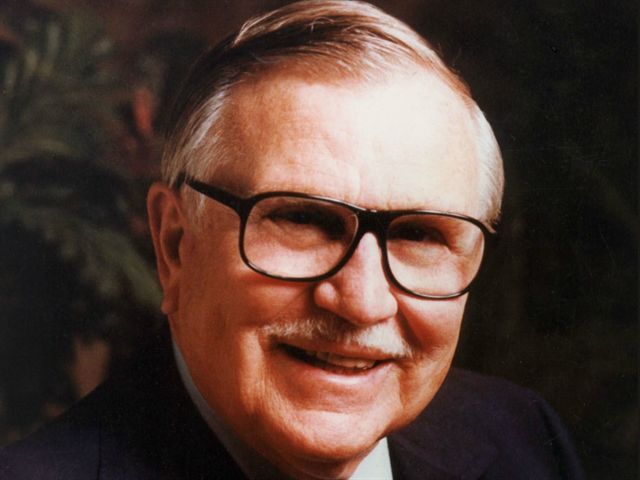
About Dr. J. Vernon McGee
John Vernon McGeewas born in Hillsboro, Texas, in 1904. Dr. McGee remarked, "When I was born and the doctor gave me the customary whack, my mother said that I let out a yell that could be heard on all four borders of Texas!" His Creator well knew that he would need a powerful voice to deliver a powerful message.
After completing his education (including a Th.M. and Th.D. from Dallas Theological Seminary), he and his wife came west, settling in Pasadena, California. Dr. McGee's greatest pastorate was at the historic Church of the Open Door in downtown Los Angeles, where he served from 1949 to 1970.
He began teaching Thru the Bible in 1967. After retiring from the pastorate, he set up radio headquarters in Pasadena, and the radio ministry expanded rapidly. Listeners never seem to tire of Dr. J. Vernon McGee's unique brand of rubber-meets-the-road teaching, or his passion for teaching the whole Word of God.
On the morning of December 1, 1988, Dr. McGee fell asleep in his chair and quietly passed into the presence of his Savior.
Contact Thru the Bible with Dr. J. Vernon McGee
Mailing Address
Thru the Bible, Inc.
P.O. Box 7100
Pasadena, CA 91109
In Canada:
Box 25325,
London, Ontario
N6C 6B1
Phone Number
(626) 795-4145 or
(800) 65-BIBLE (24253)
