Matthew 19:14—20:23
Ministries > Thru the Bible with Dr. J. Vernon McGee
https://www.oneplace.com/ministries/thru-the-bible-with-j-vernon-mcgee/
Facebook Twitter Instagram YouTubeEavesdrop on a scene when Jesus taught His disciples a hard lesson—and He did so through a story. Great encouragement and challenge straight from Jesus’ heart.
References
Steve Schwetz: Sometimes a story can reveal what we’d rather not see. Welcome to Thru the Bible. Let’s turn to Matthew 19 as Dr. McGee explains how Jesus uses a story to teach his disciples a lesson they didn’t expect, but needed to hear. As we get started, let’s give this time to the Lord. Father, thank you for knowing our hearts and knowing how best to reach us. Help us to respond to your Spirit as He teaches us your Word and humble our proud hearts, Lord, so that we can truly listen and respond in faith. In Jesus’ name, amen. Here’s Dr. J. Vernon McGee on Thru the Bible.
Dr. J. Vernon McGee: Now, last time, friends, we got into the 19th chapter, and it would seem maybe that we bogged down, but we only bogged down at important places. And last time, we saw that our Lord was discussing this subject of marriage and divorce. Of course, the question that was brought to Him was brought to Him to tempt Him, to try to put Him in opposition to the Mosaic system. And He made it very clear that Moses did this because of the hardness of men’s hearts and that the original purpose of God was that the marriage might be the tenderest and sweetest and loveliest, most thrilling relationship that any person could possibly experience in this life and that the awful tragedy was when a divorce came. He gave what is the scriptural grounds of divorce, and that of course is adultery. Now today, that’s totally ignored. It’s no longer actually a ground in California. They don’t use that ugly term anymore. Adultery is an ugly term, and it sounds so much better to say incompatibility. That is a nice-sounding word compared to the other. But He puts down for God’s people this is the basis for it. And then He brought those little children. Said don’t keep them from coming to Me. And I say again, man or woman, husband or wife, mother or father, if you’re contemplating divorce, think of the little ones. The Lord Jesus said, "Suffer them to come unto Me," and you’d be surprised today the number of little ones that have been turned away from Christ because of the separation, the divorce of father and mother. May I say that our Lord ties that together. And then Jesus in verse 14, and I’ll pick up our study there: "But Jesus said, Suffer the little children, and forbid them not, to come unto Me: for of such is the kingdom of heaven." He laid His hands on them and departed thence. "And, behold, one came and said unto Him, Good Master, what good thing shall I do, that I may have eternal life?" "And He said unto him, Why callest thou Me good? there is none good but one, that is, God: but if thou wilt enter into life, keep the commandments." Now let’s pause there for just a moment. This is a remarkable incident, and we’ll have an occasion, of course, to consider it again in the Gospel of Luke, and I probably will spend more time with it there. But there’s certain things here we’d like to call your attention to. You’ll notice how he approached the Lord Jesus. He called Him Good. Now, he was willing to concede that, and the enemies I don’t think would have gone that far. But what our Lord is saying to the young man, "Why do you call Me good?" And then He says, "There’s none good but one, that is, God." And I’m sure you see what our Lord was after. He’s saying, "Young man, no one’s good but God. Now, if you see that I’m good, it’s because I’m God." That’s the reason that the Lord Jesus does this, and so He’s leading him along that he might accept Him as the Christ, the Son of God. Then the Lord Jesus flashed on this young man the commandments that have to do with a man’s relationship to man. And let me read those. Verse 18 now of Matthew 19: "He saith unto Him, Which? Jesus said, Thou shalt do no murder, Thou shalt not commit adultery, Thou shalt not steal, Thou shalt not bear false witness, Honour thy father and thy mother: and, Thou shalt love thy neighbour as thyself." Now listen, this young man "saith unto Him, All these things have I kept from my youth up: what lack I yet?" Now, he recognized that there was a lack in his life. Yet this young man could say that he’d kept these commandments. Now, the commandments our Lord gave to him are the last of the Ten Commandments that have to do with a man’s relationship to man. The first commandments have to do with a man’s relationship to God. Our Lord did not use those because He’s leading this young man along. Now the Lord says to him, verse 21: "Jesus said unto him, If thou wilt be perfect," or complete, "go and sell what thou hast, and give to the poor, and thou shalt have treasure in heaven: and come and follow Me." Following Jesus, of course, would have led him to see that he was not keeping the first commandments, which have to do with a man’s relationship to God. This very moment, the Lord Jesus is on the way to the cross, and if he’s going to follow the Lord Jesus, he’d find himself at the foot of a cross. But there was something standing in the way for this young man. It was riches. The riches were the stumbling block for this young man. Now for somebody else, it might be something else and would be certainly would for me. Riches are certainly not my problem, friends, because I don’t have it. But will you notice what our Lord now says to this young man? "But when the young man heard that saying, he went away sorrowful: for he had great possessions." You see, this was the stumbling block in the young man’s life. This was the thing that was keeping him from the Lord Jesus Christ. Now today, you will find that there are many things that are keeping men from the Lord Jesus. Riches, one thing. Oh, there are just multitudes of other things. Actually, a church membership is keeping a lot of people from Christ. They think they belong to the church, and that puts them in a little cellophane bag, and nobody can get to them. After all, they can say, "I’m a church member. I’ve been through the ceremonies. I made my confession," and that sort of thing. But my friend, they are as unconverted as any darkest spot on top side of the earth. That would be their condition. What is it today that is separating maybe you from Christ? Is anything in the way that’s keeping you from Him? Well, it was riches for this young man. Now will you notice our Lord now in verse 23 says: "Then said Jesus unto His disciples, Verily I say unto you, That a rich man shall hardly enter into the kingdom of heaven." Not many rich, you know, not many of the great ones of the earth. I think that’s still true today. Notice what He said: "Again I say unto you, It is easier for a camel to go through the eye of a needle, than for a rich man to enter into the kingdom of God." Now, I feel that a great many people miss many times the humor that our Lord uses. Now, I’m confident that there’s humor here. And I’ve even heard this rather ridiculous explanation that there was a gate in Jerusalem that was called the eye of the needle, and a camel had to kneel down to go through, and what our Lord meant, he’d have to become humble. He’s not talking about that at all. He’s talking about a real camel, and He’s talking about a real needle that has an eye in it. And friends, let me ask you the very frank question: Is it possible for a real camel to go through an eye of a needle? I think you know the answer. He just can’t make it. It’s impossible. But would it be possible for God to do that? Well, God can put a camel through a needle’s eye, only He’s not in that business. But only God can regenerate a man, and that is the point He’s making here. It’s easier for a camel to go through the eye of a needle than for a rich man to enter into the kingdom of God. He’ll never enter in because of his riches. There are so many people today that think they’re going to be saved by what they have or who they are. And friends, you are saved when you find out who you are, and that is a sinner, and when you find out that you’re a beggar in God’s sight, and you have nothing to offer Him for your salvation. Now when you make that discovery, you’re a candidate for salvation. But as long as you think that you can do something or you can pay God, and there are a lot of people that think they can do that, why you can no more be saved than you can put a camel through an eye of a needle by your own works. You say that’s impossible. Of course it is. That’s the point our Lord is making here. It’s impossible. Now let’s read on: "When His disciples heard it, they were exceedingly amazed, saying, Who then can be saved?" Well, listen to this. This is the explanation. Verse 26 of Matthew 19: "But Jesus beheld them, and said unto them, With men this is impossible; but with God all things are possible." As far as any person is concerned, doesn’t make any difference who you are, you’re a candidate for salvation if you recognize that you are not a candidate for salvation, that you have nothing to offer God at all. And when you come to Him to offer Him nothing except empty hands and a holy mouth to Him in faith, my friend, He’ll take you and save you. That’s when He does that. Now notice verse 27: "Then answered Peter and said unto Him, Behold, we have forsaken all, and followed Thee; what shall we have therefore?" And it’s so easy to believe that Simon Peter’s betraying a very selfish streak here. Didn’t the Lord Jesus rebuke him? Well, will you notice? "And Jesus said unto them, Verily I say unto you, That ye which have followed Me, in the regeneration when the Son of man shall sit in the throne of His glory, ye also shall sit upon twelve thrones, judging the twelve tribes of Israel." Our Lord did not rebuke him. I believe that a Christian ought to work for a reward today. And Simon Peter’s saying, "Lord, we’ve made a tremendous sacrifice to follow You. Will we be rewarded?" And our Lord said, "You’re going to sit on twelve thrones, judging the twelve tribes of Israel. And every one that hath forsaken houses, or brethren, or sisters, or father, or mother, or wife, or children, or lands, for My name’s sake, shall receive an hundredfold, and shall inherit everlasting life." "But many that are first shall be last; and the last shall be first." And that is a great principle He puts down. There is a reward for those who, having been saved, sacrifice for Jesus’ sake. Many an unknown saint today of whom the world has not heard is going to be given first place in His presence someday. I believe that’s going to be one of the most revealing things when we come into the presence of God to find out that all of these that receive acclaim and are mentioned as Christian leaders, you won’t even hear from them in that day. The ones you’ll hear of are unknown saints of God. What a glorious, wonderful picture this presents to us. Now we come to chapter 20, and we have here again another remarkable chapter, but not as long. You have here the parable of the laborers in the vineyard, and Jesus makes the fourth and fifth announcements of His approaching death. And the mother of James and John requests the places on the right hand and left hand for her sons. And then Jesus opens the eyes of two blind men along the roadside. Now this chapter opens here with the parable of the laborers in the vineyard, and it’s actually a continuation of Jesus’ remarks on rewards that were begun in the last chapter. This chapter will bring to an end, I think, the section that seems to mark time in the movement of Matthew. After this chapter, the tempo increases, and he moves directly to the cross. This chapter makes an important contribution, however, to filling in some of those dark corners of the present state of the kingdom of heaven. Now will you notice that we’ve had this up about rewards in the last chapter. Now the principle for giving rewards is stated in this parable. Faithfulness to the task and not the amount of work done or the spectacular nature of it governs the giving of rewards. And you have here this first parable we want to look at. Now I’m reading chapter 20 of Matthew, verse 1: "For the kingdom of heaven is like unto a man that’s an householder, which went out early in the morning to hire labourers into his vineyard." Now this parable, you see, is closely related to the past chapter. The last verse of chapter 19, you notice: "But many that are first shall be last; and the last shall be first." Now if you drop down to verse 16 in this chapter, you’d find: "So the last shall be first, and the first last: for many be called, but few chosen." So you see at the beginning of this parable and at the end of it, why you have this verse as sort of a parenthesis to put around the chapter. Now let me just read into this parable here. Now this man, he has a vineyard, and he went out to hire some laborers to work in it. "And when he had agreed with the labourers for a penny a day, he sent them into his vineyard. And he went out about the third hour, and saw others standing idle in the marketplace, And said unto them; Go ye also into the vineyard, and whatsoever is right I’ll give you. And they went their way." "Again he went out about the sixth and the ninth hour," now that’s noon and in the afternoon. "And about the eleventh hour he went out, and found others standing idle, and saith unto them, Why stand ye here all the day idle? They say unto him, Because no man hath hired us. He saith unto them, Go ye also into the vineyard; and whatsoever is right, that shall ye receive." "So when even was come, the lord of the vineyard saith unto his steward, Call the labourers, and give them their hire, beginning from the last unto the first. And when they came that were hired about the eleventh hour, they received every man a penny. But when the first came, they supposed that they should have received more; and they likewise received every man a penny." "And when they had received it, they murmured against the goodman of the house, Saying, These last have wrought but one hour, and thou hast made them equal unto us, which have borne the burden and heat of the day. But he answered one of them, and said, Friend, I do thee no wrong: didst not thou agree with me for a penny? Take that thine is, and go thy way: I will give unto this last, even as unto thee. Is it not lawful for me to do what I will with mine own? Is thine eye evil, because I am good?" Now, this is a tremendous parable, and it illustrates this: that it’s not the amount of time that you serve or the prominence and importance of your position which determines your reward. It’s your faithfulness to the task God’s given you to perform regardless of how small or how short or how very insignificant it might appear. I’ve always felt that the Lord someday will call up some dear little lady. She may have been a member of my church. And I’ll turn to a member of the staff and I’ll say, "Do you know her?" And they’ll say, "No, never heard of her." And another one will say, "Well, she certainly wasn’t president of the choir, she never was president of the missionary society, she never taught a Sunday school class. Why, woman never did anything, and look at the way that He’s rewarding her." And we’ll find out when He mentions the reason He’s rewarding her, she was probably a widow. She had a little son. And she was faithful just bringing up that little boy. She never spoke to thousands like some evangelist or some preacher. She had one little boy. That’s all God asked her to do, to be faithful, and she was faithful. And that little fellow went as a missionary out to the field, served God out there. That’s all God had ever asked her to do. Someone says, "Well, she sure didn’t work as much as I did." No, that’s right, but He’s not going to reward you about the amount of work you’ve done; it’s going to be how faithful you were, whether you did the job He called you to do. Maybe it wasn’t a big one. But have you been faithful in that task? This is a very wonderful parable, as you can see. Now notice the movement in verse 17, and it’s geographical and physical. "Jesus going up to Jerusalem took the twelve disciples apart in the way, and said unto them," now they’re approaching Jerusalem. They’re going up out of the Jordan Valley, moving up to Jerusalem where He is to die upon the cross. And will you listen to Him now: "Behold, we go up to Jerusalem; and the Son of man shall be betrayed unto the chief priests and unto the scribes, and they shall condemn Him to death, And shall deliver Him to the Gentiles to mock, and to scourge, and to crucify Him: and the third day He shall rise again." Now you can’t spell it out any plainer than that. He’s telling these men now for the fourth time in detail at this juncture exactly what’s going to happen to Him. And do you know that somehow or another, it just didn’t fit into their program. They couldn’t quite see it. Took them a long time to get it. And it’s now very clearly understood by anyone who reads this Gospel that it’s His avowed intention to go to Jerusalem to die. Now you ponder the significance of this. He went there deliberately to die for you and me. That’s something to turn over and think about. Now at a time like this, you just can’t believe it. "Then came to Him the mother of Zebedee’s children with her sons, worshipping Him, and desiring a certain thing of Him." I’m afraid a great many of us worship Him like this. "And He said unto her, What wilt thou? She saith unto Him, Grant that these my two sons may sit, the one on thy right hand, and the other on the left, in Thy kingdom." She’s asking this for her sons. I don’t know whether to criticize her or not. She’s an ambitious mother. She certainly missed the very atmosphere and the very understanding of what was really taking place at that time. Now we find here that He says to her, and I’m going to leave out something that’s not in our better manuscripts. "But Jesus answered and said, Ye know not what ye ask. Are ye able to drink of the cup that I shall drink of?" They say unto Him, "We are able." "And He saith unto them, Ye shall drink indeed of My cup. But to sit on My right hand, and on My left, is not Mine to give, but it shall be given to them for whom it is prepared of My Father." And please don’t miss this. This is so important for Christians today. He’s not saying that there isn’t a place on His right hand and left that’s going to go to somebody. What He’s saying is this: He says, "I will not arbitrarily give this to John and to James. I’ll not just arbitrarily give this to anyone. This is for those who prepare themselves for the place." Now will you hear me very carefully in closing. Salvation, heaven, is for the asking. You do nothing, nothing in order to be saved. But my friend, your place, your position, your reward in heaven is determined by what you do down here. Don’t forget that. That’s very important. Christians have lost sight of it. He says, "It’s not Mine to give. I will not arbitrarily give it. You’ll prepare yourself for that." By the way, what kind of a place are you preparing yourself for? I have no ambition for the place to the right hand or to the left. I think I missed that one. But friend, all of us ought to work for a place up there. But you don’t work for heaven. That is by faith in Christ through His marvelous grace.
Steve Schwetz: Is that a new thought? We know that the Bible teaches that we can’t do anything to earn heaven, but as Dr. McGee said, you can’t do any work in order to get into heaven, but all of us ought to work for a place once we’re there. And the way we do that is by living in obedience to God’s Word and serving Him out of the joy of our hearts. One of the most meaningful ways to begin is through prayer, lifting up others before the Lord. It’s a starting point for so much of what God calls us to do. So as you grow in your own prayer life, we’d invite you to join the World Prayer Team as we travel on our knees around the world praying for a different country each day. And together with thousands of other intercessors, including me, you’ll bring great needs before God and you get to see Him answer them, too. To learn more about this incredible journey and how you can be a part of it, just visit ttb.org. And while you’re there, be sure to explore the many resources that we’ve got to help you grow in your own study of God’s Word. If you’d like to spend more time in Matthew, well, download our free Bible Companion and work your way through the lessons. Or use the discussion questions to go deeper, maybe even with a friend or a small group. If you’re ready to explore other books or topics, well, we got the digital library waiting for you. It’s a great place to begin with Dr. McGee’s downloadable booklet called *Let Us Pray* from Matthew 6 or maybe *One Hour in Romans*, which is a fantastic overview of the book of Romans. With more than 100 booklets available for free download, there’s something for everyone. Now, you’ll find these titles and so many other great ones when you wander through our collection from our app or at ttb.org. And if you’d like a little help, well, call us at 1-800-65-BIBLE. Again, that’s 1-800-65-BIBLE. You can also email us anytime at biblebus@ttb.org or write to Box 7100, Pasadena, California, 91109 or in Canada Box 25325, London, Ontario, N6C 6B1. Do you want to be great in God’s kingdom? Well, be sure to catch the next stop on the Bible Bus as we discover what God’s Word has to say. I’m Steve Schwetz, and we’ll see you when the Bible Bus rolls your way again. Oh, and remember you don’t have to wait until we arrive at a certain time or place. You can hop aboard anytime, anywhere through our app. God’s Word is never out of reach, and there’s always a seat saved just for you. We're grateful for the faithful and generous support of Thru the Bible's partners whom God uses to take the whole Word to the whole world.
Related Episodes
Matthew 19:1-15
Monday, August 10
Matthew 18
Friday, August 7
Matthew 16:28—17:27
Thursday, August 6
About Thru the Bible
Thru the Bible takes the listener through the entire Bible in just five years, threading back and forth between the Old and New Testaments. You can begin the study at any time. When we have concluded Revelation, we will start over again in Genesis, so if you are with us for five years you will not miss any part of the Bible.
Other Thru the Bible Programs:
Thru the Bible - Minute with McGee
Thru the Bible - Questions & Answers
Thru the Bible - Sunday Sermon
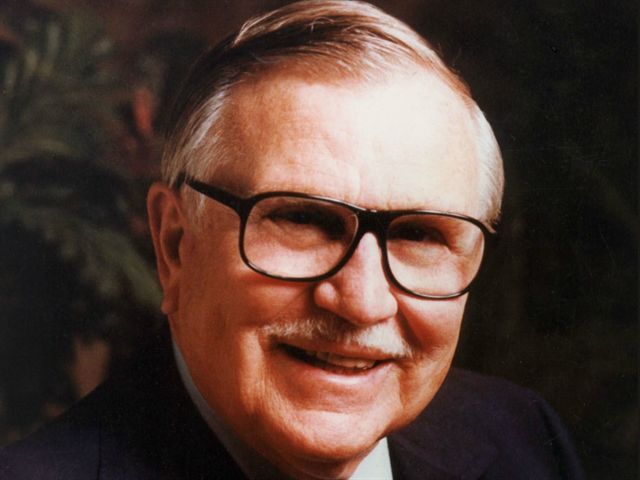
About Dr. J. Vernon McGee
John Vernon McGeewas born in Hillsboro, Texas, in 1904. Dr. McGee remarked, "When I was born and the doctor gave me the customary whack, my mother said that I let out a yell that could be heard on all four borders of Texas!" His Creator well knew that he would need a powerful voice to deliver a powerful message.
After completing his education (including a Th.M. and Th.D. from Dallas Theological Seminary), he and his wife came west, settling in Pasadena, California. Dr. McGee's greatest pastorate was at the historic Church of the Open Door in downtown Los Angeles, where he served from 1949 to 1970.
He began teaching Thru the Bible in 1967. After retiring from the pastorate, he set up radio headquarters in Pasadena, and the radio ministry expanded rapidly. Listeners never seem to tire of Dr. J. Vernon McGee's unique brand of rubber-meets-the-road teaching, or his passion for teaching the whole Word of God.
On the morning of December 1, 1988, Dr. McGee fell asleep in his chair and quietly passed into the presence of his Savior.
Contact Thru the Bible with Dr. J. Vernon McGee
Mailing Address
Thru the Bible, Inc.
P.O. Box 7100
Pasadena, CA 91109
In Canada:
Box 25325,
London, Ontario
N6C 6B1
Phone Number
(626) 795-4145 or
(800) 65-BIBLE (24253)
